
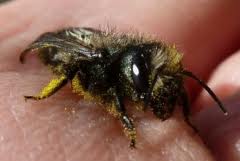
Many moons ago I purchased an organic-looking, sweet little native pollinator house. I will not go into the price I overlooked to have what I thought would be a natural, rustic addition to my garden. I found what I thought was a good spot and mounted it near some shrubs. Nothing that year, but maybe the pollinators had not received the memo. Moved it to a new spot. Nothing that year. But in the meantime I had focused on learning more about the ecology and landscape here in the Great High and Dry. Twenty years later, here is a photo of it:
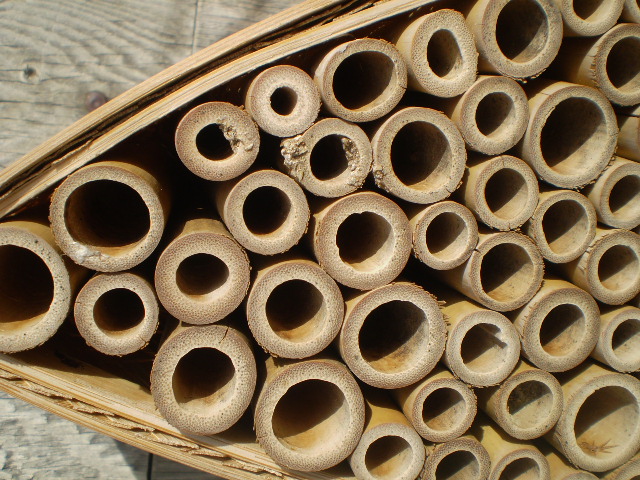
As you can see, it has been treated badly by the climate, by the sun. It is weathered. It is somewhat coming apart. And it has never been used by a native pollinator. But over the years, as I watched the little bamboo house age, I learned that the problem was not this cute little trinket. The problem was me.
To have a healthy nation of native pollinators there needs to be a specific set of elements and conditions present. To know what those conditions are, one needs to observe what goes on in one’s own garden, their own yard, their own property. Even studying everything on the Internet will not tell you what is happening in your world.
I made a point of watching for the tiny native bees, wasps, flies. When did they appear? What flowers did they love? And when nesting or hibernation or migration or dying time came, what shelter did they seek? Well, it was not the little bamboo hotel.
Here is what I learned:
The tiny mason bees and leaf cutter bees found old, abandoned beetle holes in the logs of my cabin, and those became their favorite nests.

Their second favorite nesting spaces were the open ends of the Elderberry stems after I had pruned them in the fall, and other similar shrubs which were left with a hollow stem in the garden.
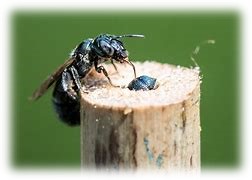
They chose old beetle holes mostly on the northeast portion of the log cabin. This is the best morning sun; it is the most protected side from the severe wind of our recidivist jet stream and the severe storms from the southwest. This allows the baby bees to come out when they are ready, not when the rains wash away their protective chewed-plant plugs.
Painfully I learned that grasshoppers on the invasion level, migrating from the hay field in front of the cabin to the pasture northwest of it, found the bee nests in the foam between the logs and ate the plants sealing the holes and then ate the eggs sealed inside. Seeing that was horribly sad, and like some kind of horror movie. Grasshoppers have a cycle of population surges every five to seven years depending on the weather and on population surges of predators, such as Praying Mantis.

So to increase a population, one increases the habitat. And with that I did an experiment with a chunk of left-over, untreated lumber by matching a drill to the size of the favored nest hole. I added a little overhang roof to help protect it from rain, and I mounted it on the east side of the cabin. Lo and behold, in fall this is what I found:

Observation: It dawned on me that these tiny holes with their green and brown seals were very small, possibly too small for the grasshoppers to get their jaws in to pull out the seals. Certainly they were smaller than the bamboo bee house, and not at all soft like the foam from the front door header.
And so Observation, Innovation and Creation burst forth from the mind of woman!!
Actions:
When pruning shrubs such as Elderberry, be mindful of the open stem and leave enough for the native bees to use as nesting sites.
I needed to make as many of the new native pollinator houses as possible; make them attractive so other folks will want them all over their yards. And so I did.

Seeds from Hybrid Blue Spirea collected at Tara Farm and Nursery from successful plants, mounting screws, and a link to Planting Guidance (found here on the website!) $8.00 (plus tax)
To Order: Send a message here, or text or call 307.262.8043,
or email tarafarmandnursery@gmail.com, or you can purchase them at Heirloom & Native Eating Counter 420 W First Street Casper Wyoming, Wednesday thru Friday 11am to 6pm.
It is so good to know that after all the work of the little pollinators resulting in fruit and vegetables for us, that they should be able to find a safer place to continue their tiny families, and then shelter to give up this life and become part of the soil nearby.
All the necessary elements and conditions are dynamic, and being met.
Bzzzzzzzzzzzz………….
 The Refuge Permaculture Center