

“I am here because you are here.” Every morning and any time I get too wrapped up in my head or with the human comedy and drama. Sometimes lie down right on the dirt in the garden. And I rest there for a few minutes. My agreement with the planet.
Dirt, soil, earth first. Let’s start here.
The soils in the Casper area are a challenge to the conventional gardener. The conventional gardener has a set of standards that they were told by a neighbor, or found online, or heard in some workshop or class. But very, very rarely is the conventional gardener taught to be patient, to observe, to note, to experiment on a small scale. And so the soils in the Casper area are a challenge. Clay and sand. They seem like the opposite ends of the spectrum. The rich, pH neutral loam soil is rare around these parts. It’s only found in limited places, like the banks of the river or in established older forested areas. But in any subdivision, the earth has been so torn up, so machine-manipulated, brought up from deep levels of the soil profile to create basements, foundations, roads and utilities. It is dead; little or nothing gives it Life.
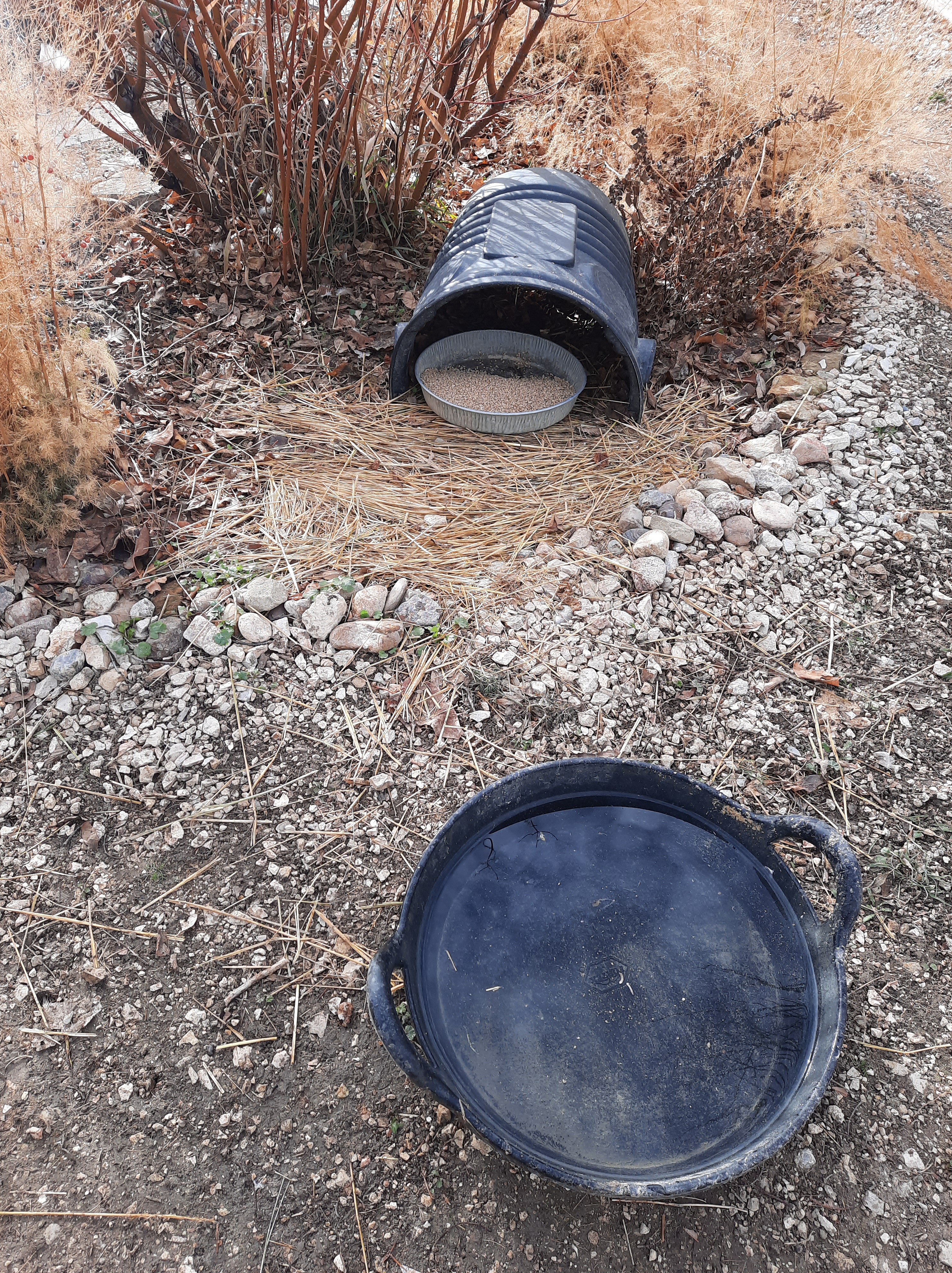
In these cases, what is there of nature left to observe, to aid in finding a way to restore that abused earth? Believe me: Life has figure it out already. We just need to pay attention.
I consider this question in the classes I teach and for now, right here.
Over the next few months I will offer posts here about my experience with dirt, soil, earth, mulch, compost, mud, rocks, fossils, microbes, fungi and all those things I have on my hands, under my fingernails, all over my mudroom floor, practically every day here at the farm – yes, even in winter. And there is a very important, ancient little story going on right now, and the plot of this story is an observation on fertile soil building. Let’s start with birds.
House sparrows and starlings. Some stay here at the farm over winter. My cat watches them intensely from the front window. Every flit and flutter.

I hear a lot of complaints about those birds. But in Spring and Summer they patrol my gardens, my nursery, the pastures and hayfields, eating thousands of insects who want nothing more than to dine on my plants. And in fall and winter those pesky “non-native” birds do even better work: they create a whole new, more fertile, more neutral soil in all the windbreaks, hedges and gardens. And they do it every winter, for free, with no help from humans.
Did you know that with the mineral compositions and the climate here in Central Wyoming it can take up to 1000 years to create one inch of top soil? One thousand years by purely natural processes.
The trick to permaculture is that we listen and look deeply, patiently. What are those natural processes and how can we encourage them with little or no harm to the ecological web?
In 2005 I installed native shrubs as wind and snow breaks in five areas of the farm: Silver Buffaloberry, Common Chokecherry, and Fragrant Sumac. These were very small sticks, tiny babies only 6 or 7 inches tall. And the test was to plant them directly into unamended, alkaline clay. They are native to our area, so the question was: what would happen if after care-taking to leaf production – a few months- I just treated them like they were wild, no human intervention except in weather extremes?
Today the majority of those shrubs are 12 to 15 feet tall or taller, highly productive, depending on the conditions at the time of blooming, and drawing their water from the subsurface moisture their roots find in all directions and a meter down.
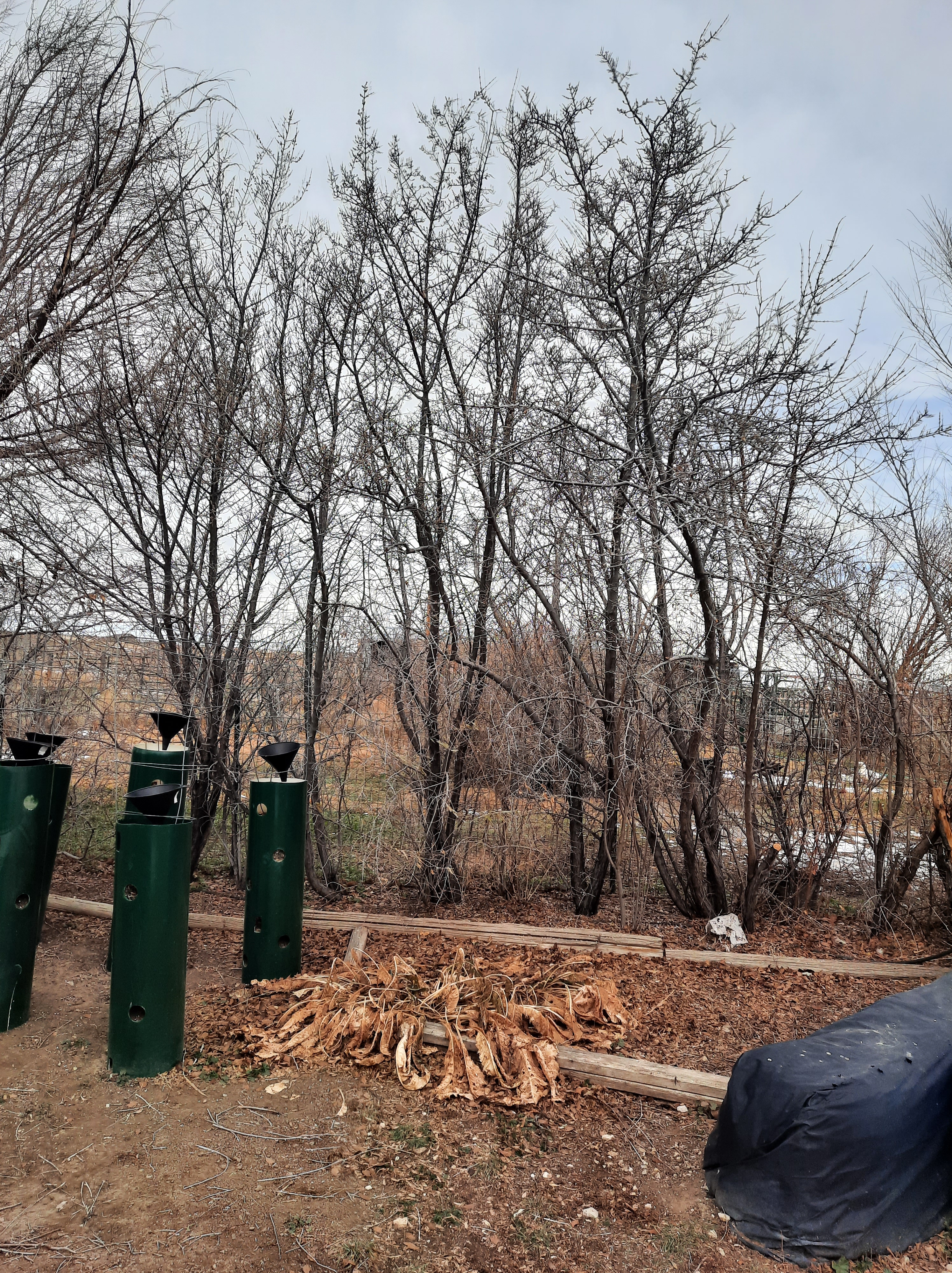
And the house sparrows and starlings are significantly responsible for this success. How?
When these large shrubs were still very small, a couple feet tall, the birds found the branches, and shaded leaves, the insects and the fruit, nesting sites and perches for their young to take the first leap into the air. And the dense branches provided some shelter in the winter, open just enough to let the warm sunlight through. Much of the fruit, well above my reach, dried on the shrubs, and the birds picked at this fruit all through winter.
When the air was calm the birds resting in these shrubs relieved themselves directly to the ground below. The ground under the young shrubs is as white as if snow had fallen all day. The breezes and gale warnings blow the bits of partially-eaten insects, string, hair from cow tails, feathers and leaves from Spring nests down to the ground adding organic matter and material to decay in the ground below, mixed with the droppings of their food and guano from their warm little bodies.

All this lies on the top of the soil until the snow melts and the Spring rains come, and the birds begin picking and scratching at the soil for the insects hatching from the ground and tiny rocks for their gizzards to grind their food. Their claws and beaks cultivate the surface and mix the melting manure and all the bits and pieces into the soil. As more water soaks in all of this is flushed into the soil profile, boosting the available natural fertilizer of nitrogen and acids for the plants to use to come out of dormancy. Soon, to bloom.
It is that simple. One thousand years of work performed by nature, focused by human garden design, overcome in a matter of a few years.
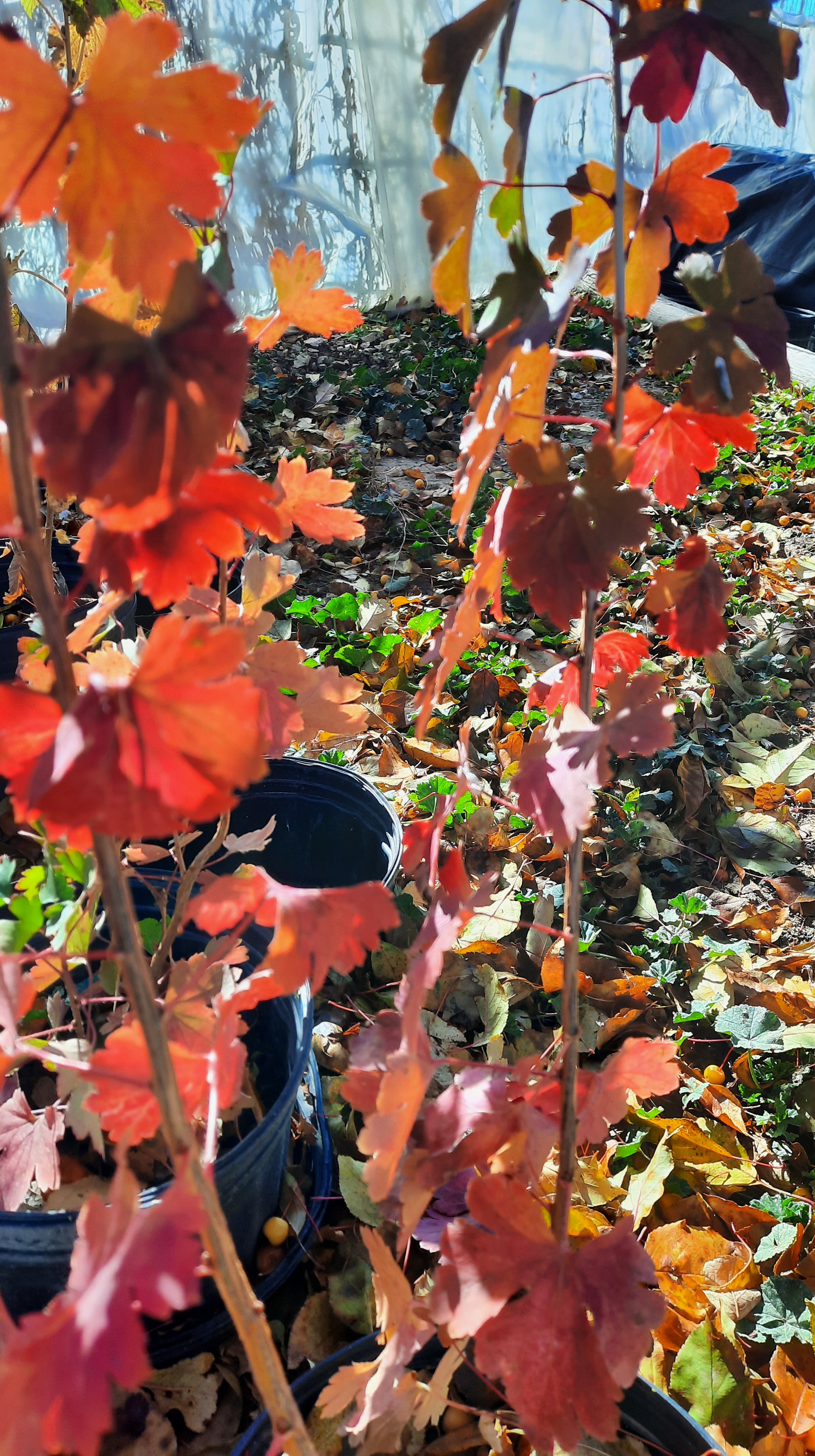
In the fall, the leaves shut down in vibrant reds and golds and drop, creating a layer of perfect mulch. The first rains and snows soak and compact the leaves. Against the still-warm earth, the bottom layer begins immediately to decay, sticking together and sealing the season’s fertilizer and organic matter and moisture around the plant. Whenever the earth is not frozen – warm weeks or snow melt – the decay continues. Natural mulch and future compost, increased by the birds to pure gold for the soil.
How can you help the dirt become soil?
Start with native or hybrid/ native shrubs or trees. Buy locally or find someone who is willing to let you take cuttings or collect seed. Why local? Because these cuttings have most likely already been exposed to any local fungus, bacteria, viruses and pests, and have therefore survived and probably developed ways to avoid damage, even including an immunity.
Chokecherry pits are hard as rocks. But they are treated by the process of bird digestion. The bird eats the fruit, the sweet pulp digests easily, but the pit goes right through the process: acid bath, grinding in the gizzard, another acid bath, another grinding; the pulp is processed and the seed passes through to the ground. The freezing of winter weakens the hard seed shell. The snowmelt and warm rains of Spring swell the dry seed and help to crack the hard shell. The seed on the ground is covered by bird poop and decaying material. The perfect combination of events to hethe seed sprout. (I actually treat chokecherry, wild rose and plum seeds this way using apple cider vinegar for the acid bath and a mortar and pestle to very lightly grind. Just giving Nature a bit of a nudge.)
These babies or seeds will be the upper canopy in what permaculture refers to as a “food forest”. This “food forest” can also serve as a windbreak, or privacy screen. The list of “food forest” benefits goes far beyond these protections: low-maintenance; home-grown food; leaf mulch; beautiful flowers and fragrance in the spring; shade in the summer for cooling and moisture retention; winter-hardy; tolerant of soil chemistry; drought-tolerant; wildlife habitat to enjoy and to work with you, members of the team.
One management note: Chokecherry creates suckers like the world was ending! If you plant them toward the front of your hedge/ food forest and leave an open area for mowing you will save your sanity as well. Plant the other elements of your hedge/ food forest mixed in behind the chokecherry shrubs, and prune the chokecherry to forms that are more easily managed, keeping the lower part of the shrub open to work around.
At the moment, the starlings are fighting over who gets the last winter nesting site on the log cabin corner and the sparrows were warning me this morning to get out of their hay shed territory. The barn cat is dozing in what little sun there is. No one is the boss around here. But we all know the plan. Peace.

UpComing Classes on Soil and Food Forest:
Permaculture Soil Improvement OLLI Casper College Class: 23 May 2026 9:00am to 4pm
Food Forest: Fruit Shrubs in Your Landscape (with 307 Fruit Co.) : 6 June 2026 10:00am to 2:00pm
#tarafarmandnursery #therefugepermaculturecenter #casperwyoming #permaculture #foodforest #ecogardening #nativeplants #buffaloberry #sumac #chokecherry #soil #soilimprovement #fertilizer #naturalfertilizer #mulch #compost #birdhabitat #buildinghabitat #homegrownfood #nativefruit #fruitshrubs #wintergarden #garden #wyominggarden #interbeing #zengarden #nomudnolotus
 The Refuge Permaculture Center